Chat with P.N. Rasmussen on Social Europe, 28 November 2005

rafa: Do you think the EU should increase its presence in Northern Africa in order to avoid massive immigration from this part of the world?

PN Rasmussen: yes I do, but in a very focussed way; Europe must help to create the fundamental conditions for limiting long term immigration to Europe through better economic, social, employment progress. And Europe must be clear and consequent in its demand for a respect of human rights, workers rights, full democracy.


chourka: Dear Poul, well done for your open letter to José Manuel Durao Barroso. Won’t a more social Europe need a stronger and more integrated PES ?

PN Rasmussen: Yes and we have already taken the first important steps in our PES Leaders' Council Meeting in Vienna. Actually, we are now having a more visible and active party but we could be even stronger. Therefore our new initiative on making more growth and better jobs and our initiative on social europe does pave the way. Together we can make a stronger PES in close cooperation with our member parties. We will both be better off and most important, our citizens of Europe will be better off.

Paluckas: Recently I've read a communicate from European Commision about tackling demographic problems in EU. Aren't these issues totally under competence of national states?

PN Rasmussen: Yes the demographic challenge is first and foremost in national competence. It is also our challenge and responsibility as socialists and social democrats. We must develop our common vision and road ahead so that we have a welfare and social decent alternative to the neo liberal approach, which means a race to the bottom. Again we can unite social progress, better employment, a better intergration policy with sustainable answers to the demographic challenge. We have just made a report which has been unanimously confirmed by our leaders.


PSOUG: One talks about Bolkenstein’s directive again. What future for public services? Hospitals, energy?

PN Rasmussen: The PES has a very clear position as agreed in Stockholm in Feb 2005. We will always ensure that a well functioning public sector including health, education, hospitals, schools, elderly care will be a part of our social Europe. Actually, we succeeded in the European Parliament's Committee on Internal Market to ensure that public services is up to the member countries to define. This is just to tell you that the market will always be a servant to people and not a master.

Boris: Dear Poul, do you think social democratic parties accross Europe understand our values in the same way? Fact is that there are differences between them. In some countries they appear even to be very liberal. Don't you think that PES should play bigger role impacting policies these parties are making?

PN Rasmussen: I think that all our member parties share our common fundamental values. But obviously the different countries and thereby also our member parties do find themselves in different situations when it comes to economics, material wealth, actual history. It has been confirmed in Vienna Council that we are decided to make progress on our common road map, which means we insist that new social security, competitiveness and more and better jobs are not contradictions but preconditions based on our values. I can assure you that the PES will intensify its contacts to member parties in Europe's capitals. I was very encouraged when all our Leaders and PM gathered at 10 Downing Street, on the eve of the Summit unanimously agreed on our new action program for growth and better jobs and structural reform our way. So we can make things in common and the PES will be the front runner in doing so.


manu: Is there a PES campaign on Social Europe?

PN Rasmussen: Yes, there is. We will be all over Europe in the minds and hearts of ordinary people. We will engage together with our member parties to make that new direction, to make that new feeling that we can change to the better, the PES and its members together. The political fight has to go on on all relevant democratic levels - locally, regionally, nationally and at the European level. That is why social Europe is a fundamental, common, political, work to do. The market economy has for too long been the only cross border voice. Now we want to enhance the market economy to ensure its optimal function, ie to create jobs, to co-ordinate public and private investments in all our member countries, to ensure best practice. Again, it is our ambition to realise the coherent alternative to the neo liberal approach. Europe can compete in the new world without giving up its fundamental social security - It is about reforms, not race to the bottom.

Paul: Shouldn’t the EU protect its countries and people from the forces of globalisation?

PN Rasmussen: Yes, if we could but we can't. The globalisation will not go away. We have to face up all the challenges through an offensive PES policy. Each time when jobs are delocalised or outsourced, we must create more and better jobs in Europe. Each time, when a region is hit by delocalisation, we must take new initiatives to create new prosperity and development for that region. That is our obligation, not to try to stop the globalisation - we cannot but to invest in people so that they can have new jobs, new social security, new prosperity. To that purpose, we need a strong social state, modernised but still based on our values and a strong European co- operation with high growth and stronger progress on the Lisbon objectives. One of the most important ones are women's employment and participation in the labour market.

Alexander: How social is a Europe in which people from new member states aren’t allowed to work in Western Europe?

PN Rasmussen: I think we can do it but we have to see the clarification of the service directive and thereby also workers situation in Western Europe. Like in Central and Eastern Europe, they are worried too about future jobs. So let's try to work for a common understanding, which must avoid that workers are set up against each other. Imagine that in the service directive, we could agree that workers will be ensured working and salaries in the countries where they work - then I think Western European countries would be much more willing to consider a quicker realisation of free movement of workers from our new member countries.

max: more than 20% of young people unemployed in Europe. Isn’t it time to react?

PN Rasmussen: Definitely - Europe should have reacted a long time ago ! But seriously, we can act now to bring down youth unemployment. This is the most important task in our employment policy. But this is demanding a coherent set of approaches which include stronger national investments in education and skills, stronger active labour market policies which combines corporate social responsibilities with youth training and first and foremost higher growth and more jobs. I think there's a strong specific need to invest direct in jobs and education for the part of our youth still did not get a chance to qualify after primary school.

Moderate: Dear Mr. Rasmussen, do you think it's possible to talk in a social modele and social justice, when half the population is working hard, and the other half is getting subsidies? Do you think is it socialy fair?

PN Rasmussen: No, not if your picture was the real world. We have shown for long that people want to work. 20 million unemployed and too low growth in Europe is not a natural law. We have shown in Scandinavian countries that you can have full employment and high social protection all at the same time.

jean-phil: Haven’t the socialists failed by using old recipes in addressing globalisation ? The unemployment rate is very low in the United States. Everybody has a job!

PN Rasmussen: We have full employment in the Scandinavian countries too. Nobody is working below limits of poverty, very few are excluded. We can unite the right form of social secrurity with competitiveness and full employment. And we will do that for the rest of Europe through new growth and reforms of the right kind. We do not need to copy the USA. Our Europe can survive and we know how.

Kévin: Do you think that full employment, as presented in Lisbon is still a current matter ?

PN Rasmussen: Yes I do. We were closer in Lisbon 2000 and we will move again through our common action programme and higher growth which can finance the Lisbon progress, including new education investment. Here you have the good circle.


Tadeusz: In the European elections, PES parties did not win many seats in the European Parliament: how can we create a social Europe if we’re in a minority?

PN Rasmussen: That question goes for the nation states also. It is simple. We need to work all the time on the actual conditions. The work in the EP has shown that we can make alliances which make a difference. For example, working time, harbour services, and getting rid of Mr. Buttiglione.


Indalecio: good afternoon, now in europe the activist are members of one political and national party, we want to know if the PES is working in individually joinnes to european political parties, sorry for my english and thank you for answer

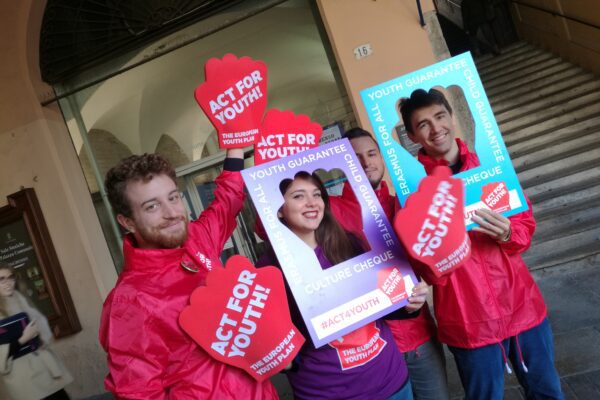
PN Rasmussen: It is an enormous and important step we have taken to involve activists in our party work. I hope that many will join us - we can make a lot together. Our activists will be an important part of our visibility and connection to national activities. It is a pretty good start and let's show in the coming months about Social Europe, about people's dialogue on the future of Europe, about winning national elections, about creating stronger consciousness about our Europe that our activists make a difference. We will start soon in the new year when the members of our parties can become PES activists. Let's make it a success and then we'll see for further steps.


Catherine: Don’t you think the EU is just a business project?

PN Rasmussen: No, but there's a risk. You know it is like in national politics, if you don't fight, you don't count. We have one market, one currency, now we must have our Social Europe. That is our Europe.


tompe: Mr Rasmussen: what does a normal working-day look like for you?

PN Rasmussen: It is not normal - not at all. But it is fantastic. It is a privilege to work all the time for what you believe in and to do it with a motivated and devoted team here in the PES office. Promise me to stay with us - together we can change Europe for the better.

Chourka : Pourquoi l'action des Commissaires européens socialistes ou sociaux-démocrates n'est-elle pas plus mise en valeur ? Je pense bien sûr à Margot Wallström mais surtout à Vladimir SPIDLA qui a en charge les Affaires sociales et l'Emploi !

P.N. Rasmussen: Commissioners from the PES family are in fact very, very busy in their different portfolios, even though they don’t always make front page news. Margot is launching her Plan D – for democracy, dialogue, and debate – on Europe’s future, which will be a listening exercise with civil society, social partners, national parliaments and political parties. This will allow us all to take a step back and listen to each other about what we really want the EU to do in the years to come. Vladimir is also very busy working on how to face up to Europe’s demographic challenges – more work-life balance and such – and there will be proposals next year on how to do that. Let’s not forget other Commissioners from our family like  Peter Mandelson on the Doha Development Round, Gunther Verheugen, Danuta Hübner,  Joaquin Almunia and Laszlo Kovacs who are working with member states to generate more growth and enterprise in Europe. We try to give them constructive support in their work. 

Paluckas: Well, there is a question raised "How can Socialists work together for a better Europe?". My question is can we work together at all. I am socialdemocrat from a new member state and in our party we feel lack of competence in european issues. Aren't we a burden for more experienced comrades?

P.N. Rasmussen: On the contrary, parties from the new member states have very much enriched the Party of European Socialists. A different dynamic has emerged in recent years. We welcomed these parties as members even before the 1 May 2004 enlargement. So the short answer to your question is that no they are not a burden, they make invaluable contributions and are the heart of the work of the PES.

Chourka : N'y a-t-il pas contradiction entre les partis membres du PSE et le PSE lui-même ? En effet, lorsque les premiers demandent de manière contradictoire "une autre Europe" ou "une Europe plus sociale" et simultanément refusent de laisser à l'Union le soin de légiférer sur le social (retraite, chômage…).

P.N. Rasmussen: I see no difference between the PES and its member parties. We are one and the same. The PES reflects the common ground between the member parties and their common will to work for a social democratic vision and policies at European level. All of our parties want a more social Europe and there are many ways to achieve this through national and European efforts. Our PES New Social Europe initiative will run over the next year and will allow our member parties to exchange experience and discuss a common direction.

Histrion : En tant qu'institution politique n'avez vous pas peur qu'un fédéralisme à l'américaine s'impose pour l'Europe aussi ? Avec ce que cela implique comme faible rôle d'un éventuel "gouvernement" européen, un libéralisme exacerbé, et l'apparition d'un bipartisme assez inerte ?

P.N. Rasmussen: No I’m not afraid at all because that is not our goal as a political organisation. Our goal is to have a Europe that supports member state efforts towards building socially just societies that can face the challenges of globalisation with confidence. Socially cohesive societies adapt to change and remain competitive far better than societies in which poverty is rife and people do not achieve their full potential. The EU can help us manage globalisation and its consequences better. It is deceptive to talk of a European government. The EU cannot be compared to other systems of government in the world, because there is nothing like it: it is the most innovative and successful form of regional integration ever established and we must make it even more effective. 

Paluckas : Recently I've read a communicate from European Commision about tackling demographic problems in EU. Aren't these issues totally under competence of national states?

P.N. Rasmussen: Yes, the questions relating to the demographic challenges of ageing and population fall are primarily under national competence, but there is a real added-value in examining the question at European level because we are all facing the same challenge. The key question is: can we learn from each other and help each other face this common challenge? The EU can play a role by providing structured coordination to this mutual learning and encouraging mutually reinforcing efforts.

Simon PL: How real the common European socialdemocratic policy on Europe and its future is possible if there are a lot of differences among member parties themselves? Let’s give the example of French PS on the so called European Constitution… 

P.N. Rasmussen: There will always be differences and this is the richness of the socialist family. We should not be afraid of debate or having different views. But at the same time, we share the same values and principles. And we know that we are stronger when we speak with one voice. The PES is embarked on a long journey in which European politics are becoming more and more important. Together with strong member parties in every member states, the PES can make a difference. This is what we all want to achieve.

Gintautas: Liberals consider Social Europe as main threat to competitiveness and economic growth, is it possible that we have not enough of social security and that's why we have competitiveness problems and other one's (like in France)?

P.N. Rasmussen: Social Europe is an essential component of the European model and is not at all an obstacle to competitiveness.  In light of globalisation we must however reform our models.  We are for structural reforms but the right ones and what we need to do is to properly combine flexibility with security.  We need to equip everyone with the right training and right skills so that changing jobs is easier.  More investment in education, lifelong learning, childcare facilities among others is essential.

Gintautas: In Vienna PES introduced a notion of 'PES activist'. It is a very important initiative, but haven't you considered further steps, like PES trainee with scholarship and so on...?

P.N. Rasmussen: As you say the launch of the PES Activist early next year will be a very important initiative. We could always go further, but our goal is to implement well the mandate that we received from the member parties in Vienna.

Boris: Could PES invest in the education of its young members who could be basement for renewal of parties in some countries?

P.N. Rasmussen: Yes, we do so! The PES is enjoying an excellent relation with its youth organisation, ECOSY, with whom we work closely.

AndreaP: Do you agree that this great ideological debate about 'the Future of Europe' as captured pro-Europeans' attention for too long now to the detriment of the real work the Union does? If so, then what practical steps can we take to make the connection to Brussels on a more realistic level?

P.N. Rasmussen: Europe seems to work best when it has a ‘big idea’ to work to – the single market, the single currency, enlargement etc. But the ‘big idea’ has to be in the direction that people want. The European Union can connect better to people when it talks about the things that matter. People today are worried about the future – their jobs, globalisation, Europe’s economy and social protection. For me connecting Europe to people is about providing answers to how we can combine modernising our welfare states, becoming more competitive in the global economy world and creating new and better jobs. This is a big challenge, but we have to face it. This is why we are launching a major debate in a New Social Europe.

Kévin: Bonjour, pensez-vous que la Turquie a vocation à entrer dans l'Union Européenne ?

P.N. Rasmussen: The opening of negotiations between the European Union and Turkey on EU accession is the start of long road. The European Council has decided that, Europe and Turkey should travel together with both parties having as their final destination Turkish membership of the European Union. The Party of European Socialist supports Turkey’s European aspirations and wishes to help Turkey complete the journey. A delegation of the PES High Level Advisory Group visited Turkey, 12 and 13 October 2005, and met with many people. We know that progressive forces and civil society in Turkey – trade unions, human rights organisations, social democrats – see Turkish entry as the best way to secure democracy, freedom, rights, stability and economic prosperity in Turkey.  The EU must make it clear to Turkey that there will be no double dealing. Membership will not be granted automatically and Turkey needs to fulfil the requirements in full. The negotiations are not bargaining over which criteria Turkey meets. But the rules of entry are clear and cannot be changed. Turkey must not regard the reform process as a series of concessions to the European Union. Turkey must strive for better human rights, democracy, rule of law, equal treatment for women and minority rights because these are essential requirements for any decent society regardless of EU membership. This major reform process will take time. The outcome is not guaranteed, but we have a common interest to ensure that Turkey stays as belonging in Europe.

PINCH009 : L'ENERGIE DOIT ELLE RESTER UN VRAI SERVICE PUBLIC

P.N. Rasmussen: The PES is interested in the renewable energy agenda. At our Council meeting in Vienna in June 2004, we adopted seven priorities, one of which was to be more ambitious regarding renewable energy. We called for a common effort from the Commission and member states to double the current target of 12 per cent of total energy produced from renewable sources.

Kévin : L'idée d'un salaire minimum sur un plan européen est-elle possible, face aux inégalités entre les différents Etats ?

P.N. Rasmussen: That question relies on each member state.  It is true that countries have different economic structures so creating a uniform minimum wage is not realistic.  But we will do all that is possible to avoid a race to the bottom. That is why the PES now has stated the work to develop our New Social Europe.

Alexander: How social is a Europe in which people from new member states aren’t allowed to work in Western Europe?

P.N. Rasmussen: That question was left open to each member state.  Some member states decided to open their labour market, others preferred to wait.  It is a choice each member state took and we must understand that each labour market is different.  Now, free movement is one of the key ideas of the European project and it needs to be for everyone.  Nonetheless, let us not forget that it is not the first time this happened.  When both Portugal and Spain joined the EU, the transition period was even longer!  It was shortened after a few years when everyone realised the fears of massive migration did not materialise. 

Paul: Shouldn’t social policies be decided at national level, rather than being dictated by Brussels?

P.N. Rasmussen: Social policies are not dictated in Brussels!  Social policies are mainly decided at national level and the European dimension is complementary.  We need to ensure that both the national and European dimensions are coherent and inter related.

Kévin: Peut-on dire aujourd'hui que l'idée d'Europe sociale a été une avancée pour les citoyens européens ?

P.N. Rasmussen: Yes, I think that the idea of Social Europe has already delivered some progress to European citizens. It means that the EU is meant to be more than just an Internal Market. It is a Union in which we also have rights and standards for workers and citizens. We have a legal basis in the EC Treaties to act in social and employment affairs at European level where it is necessary. There are EU-wide standards and practices for working time, for social dialogue, for non-discrimination, including over 30 directives in social and employment matters to uphold the rights of workers and ensure good working conditions. I think that’s progress, although of course we can and must do more.

Gintautas : Isn't it a contradiction when EU issues 'work visas' for third country citizens and do not open their labour markets for new member states? UK's, Ireland's and Sweden's examples show that it is not a threat; it's an opportunity, isn't it?

P.N. Rasmussen: Enlargement is a unique opportunity for Europe.  It is a dream come true, we have east and west together!  The opening of the labour market is a national decision and member states need to assess the proper timing. 

Darik BG: Mr. Rasmussen, a question on behalf of Bulgarian National Darik radio. Before the elections in Bulgaria, the Bulgarian socialists - the biggest party at the coalition, which now rules Bulgaria, has promised to do its best to continue the exploitation of Bulgarian Nuclear Electricity Central in Kozlodui which according to the Treaty, already signed by Bulgarian government and EU has to be shut down until Bulgarian membership in EU. My question is – do the Bulgarian socialists have to keep their promises, re-considering the Treaty between the country and EU in the context of the Central in Kozlodui?

P.N. Rasmussen: The Accession Treaty is signed and already ratified by the Bulgarian National Assembly as well as by number of EU Member States' Parliaments. The Bulgarian socialists as well as the coalition government in Bulgaria have never had the intention to renegotiate this Treaty. On the contrary, they stated their firm will to fulfil all requirements and commitments. Regarding the Kozlodui Power Plant - a sensitive issue both for Bulgaria and the EU - I believe however that we should be prepared to view the closure dates for Units 3 and 4 flexibly until new generation capacity can come on stream in Bulgaria, without in any way compromising safety requirements, which remain an absolute priority, as stated in the Progress report.

Newcomer: do you think social Europe is possible with enlargement?

P.N. Rasmussen: We must conciliate deepening of Europe with enlargement.  Enlargement inevitably raises new challenges for social policy.  But look at the effort new member states did to incorporate the social policy acquis into their legislations?  This was and still is a huge effort! The European project is about Solidarity. Despite the differences, social policy is today a reality in the whole of the EU.  The PES is precisely undertaking an initiative to identify common ground and to put forward concrete measures on how to move forward.

Guy: How could Europe be more social?

P.N. Rasmussen: Guy, I think Europe could be more social by helping people out of poverty, out of unemployment, and into good work and a high quality of living. We still have a lot to do if you consider that there are 19 million unemployed in Europe and 68 million in poverty. We need a new deal between governments, trade unions and businesses in order to make Europe more social, and governments can play a leading role in making this happen. Our starting point must be active public policies, including coordinated intelligent public investments across the EU that stimulate private investments and generate jobs.

Totuus: How do you see the future of the agriculture in Europe? My grandparents had a small farm and they could in that time make a living for five children. Is it only the big farmers now who can survive? Do we still need to substitute them more than other workers...?

P.N. Rasmussen: The PES believes that we should manage the forces of globalisation so that the market becomes the servant of the people and not vice-versa. Changes in the agricultural sector have emerged in response to an increased rate of globalisation. We cannot shy away from this. As socialists and social democrats we have to enable people, if necessary, to move from one job to the next, from one sector to the next, in a new world of increased uncertainty. In these circumstances, the PES is a stanch proponent of active labour market policies, that is to say, re-skilling people to enable them to change jobs and overcome this insecurity.

Aleksander: Comment obtenir des Leaders et des partis-membres une coordination effective avant, pendant et après les "Sommets trimestriels des Leaders" ?

P.N. Rasmussen: Good question. In fact, there’s a lot of backstage work that takes place in the PES. The PES Presidency meets on a regular basis with me, to ensure constant coordination between our parties. The silent foot soldiers in the PES secretariat and in the international departments of our parties do marvellous work following up on each of the Leaders’ meetings and making sure there’s constant coordination. 

Aleksander : Why aren't we vote the orientation of the PES? That way, there will be a common majority position on different issues rather than a fake consensus without any implementations possible.
P.N. Rasmussen: Every 2 ½ years, the PES Congress meets and votes on the direction of the PES. We always try to reach consensus because in that way all parties feel fully part of our common decision. It is not about watered down consensus but strong consensus with content. If we do not find a consensus PES voting follows the voting established in the EC treaties on each policy area. The consensus we achieve on issues like the Lisbon Strategy is real and allows us to pursue a strong and united front at European level in order to influence the EU policy agenda. 

Liliane : It’s often said that we need to get more women back to work, but how can that happen when there’s such little child care and so much discrimination in the workplace against women?

P.N. Rasmussen: The PES is committed to better conditions for women to enable them and their partners to balance work and family commitments. You are right that in some parts of Europe, childcare provision is in short supply and there still exists far too many cases of discrimination in the workplace. However, there is a mixed picture in Europe on this issue. Some member states have got the balance right. In Sweden and Denmark, childcare provision and parental leave provisions are very good indeed. Other member states have started to look to these countries for inspiration as to how to improve their situations. We have to push all member states to provide accessible and affordable childcare and ensure that anti-discrimination measures are enforced.

Jedisaime: quel candidat socialiste voyez-vous pour les élections présidentielles en France ?

P.N. Rasmussen: I was recently at the Congress of French PS and I am really happy that they reached unity in Le Mans. As far as the presidential elections, it is still a long way to go and I am sure that the best person will be chosen and will beat the right wing candidate. It is better to have more personalities than none at all.

Moderate: Which country do you think is a bigger threat (or not) to the Social Europe? China or India?

P.N. Rasmussen: Globalisation is here to stay and therefore Europe must find the best way to strengthen and preserve its social model. We are glad that people are lift out of poverty India and China. We could not have a different approach to that. As social democrat we also want to see the living condition of the people be improved but also their working conditions. Therefore we support decent work for all, with workers rights, equal pay, collective bargaining. This is the key for a successful economic globalisation: the globalisation of social rights!
Samf: Mr. Rasmussen, do you think to get a more equitable world we need to cooperate with all the US-Democrats or the progressive wing of the Democrats? Why we don't see a close cooperation between the PES/ Socialist International and the progressive/left-wing democrats?

P.N. Rasmussen: I agree that we must join forces with progressives around the world in order to tackle common challenges and achieve a fairer global order. We do cooperate closely with the Socialist International and have an initiative called Global Progress with Democrats including Madeleine Albright and Tom Daschle. Global Progress is now working on how to promote decent work as a global objective.
Varanasi: membre du PS et signataire de la motion 3 (Utopia) le PSE pourrait il lancer le débat d'un REVENU  EUROPEEN  D'EXISTENCE , ce qui à mon sens, changerait complètement le rapport de forces Patronat, salariés.

P.N. Rasmussen: The PES has just launched an initiative on Social Europe where that and other questions will be discussed and analysed.  That precise case is however a decision for each member state to take.  Most Members already have minimum guaranteed incomes schemes in place.

Samf : What do you think should be the cooperation between the PES and the Socialist International?

P.N. Rasmussen: The PES works closely with the Socialist International, which is the platform organisation of all socialist, social-democrat and labour parties in the world. I am convinced that the cooperation between the PES and SI reinforce each other with our respective role. We want SI to be strong all over the world and SI speaking with a strong voice on all international issues.

Kévin: Le chômage des jeunes et des plus de 50 ans ne marque-t-il pas les limites de la social-démocratie ?

P.N. Rasmussen: I would add women’s unemployment!  Those are very serious problems that we as social democrats must face.  The way out is to look at the Scandinavian countries:  they were able to combine flexibility with security.  The key for that is investing in people, in their training and skills to prepare them for the challenges of the 21st century!  More investment in childcare is also key to integrate more women in the labour market.

Joker: Une zone euro à géométrie variable (et sans Angleterre surtout)... Idem avec l'espace des frontières... Un traité qui n'est pas présenté à tous de la même manière... Comment construire une Europe socialiste si tant d'obstacles divisent même les socialistes entre eux ?

P.N. Rasmussen: The EU has always overcome crises and I think we’ll overcome this one. Now it’s about uniting around common goals and delivering on the things that matter to ordinary people. All socialists believe in that. That’s why we developed our growth and investment strategy “Acting together and simultaneously: higher growth and more jobs”. It is only by delivering on the concerns of ordinary people for more jobs, security and prosperity that we can get the EU back on track.

Marco : pourquoi sanctionner les chômeurs et supprimer leurs indemnités?  Ils ne sont pas responsables de leur situation! Il faut créer des emplois pour tous.

P.N. Rasmussen: Of course unemployed are not responsible of their situation.  The PES is committed to full and quality employment which should be a priority for Europe.  Investment in people is the key to change.  At the same time we must be capable of reforming our social models.  Europe must change.  This does not mean suppressing workers rights but simply enable each one to be better prepared and equipped for change.

Moderate: You spoke about making alliances? With Communists, Greens, Liberals, Christian Democrats, regional parties?

P.N. Rasmussen: I mean alliances in the broad sense, rather than with one political group or the other. I think the mistake is to think that alliances for change can only made between politicians. On many issues, alliances must be sought with civil society, with trade unions, business, with ordinary people at the end of the day. National politics cannot be made in a vacuum, and nor can European politics.

Samf: please Mr. Rasmussen try to make more chats about other issues

P.N. Rasmussen: I definitely will. All questions asked today were very interesting and there are many subjects I would like to debate with as many people as possible. Future chats will be advertised on the website.

Justin: Good afternoon i want to read something about your party and your theory. I read a Antony Giddens book but i would like to read something specific about your party your social politc economic project. Thank for the attention.

P.N. Rasmussen: Thanks for your interest. I can recommend the history of the PES which describes how we have developed as a party for a start. We have also launched a series of PES publications this year on different themes which explore the thinking and debate within the PES: so far you will find publications on Social Europe, meeting Europe’s demographic challenges and our growth and investment strategy. Our book on “Europe and a New Global Order” explains our social democratic approach on making globalisation fairer and establishing a better system of global governance. All of these can be found on the PES website. I hope you find these interesting!

Dd: Ne pensez vous pas que la constitution a manqué d'un volet social ?

P.N. Rasmussen: It is true that during the convention the economic and social debates were unfortunately the ones that advanced least.  But let me be clear when saying that sometimes there is European social law that is not respected by member states.  But it is true that we can move further.  The PSE is launching an initiative precisely to define how to move forward.

Becky : what is your opinion on the trade union and Labour party link? Should it be a formal affiliation or not? Other countries survive without such formality?

P.N. Rasmussen: The PES recognises that its member parties have different histories, structures and systems. The Labour party grew out of the trade union movement and this explains the formal links. Some of our member parties have formal links with trade unions, others do not. There is not and should not be a one-sized fits all approach.


<

September 2008

>
M T W T F S S
1- 2- 3- 4- 5- 6- 7-
8- 9- 10- 11- 12- 13- 14-
15- 16- 17- 18- 19- 20- 21-
22- 23- 24- 25- 26- 27- 28-
29- 30- 1 2 3 4 5
-
Manifesto 2009
Sofia 2007
internal links clic to see: PES @ctivists clic to see: PES newsletter